
Introduction
In India, product quality and safety are regulated through the BIS Certificate system. Whether you are a manufacturer, importer, or business owner, understanding BIS Certification is essential to legally sell products in the Indian market. This blog explains everything about BIS License, BIS Licence, and BIS Registration in a simple and clear way.
What is BIS Certificate?
A BIS Certificate is issued by the Bureau of Indian Standards (BIS), the national standard body of India. It ensures that a product meets the required quality, safety, and performance standards. Products with BIS approval are considered safe for consumers and compliant with Indian laws.
What is BIS Certification?
BIS Certification is the process through which manufacturers obtain approval from BIS to use the standard mark (ISI mark or CRS mark) on their products.
This certification confirms that:
- The product meets Indian safety standards
- The manufacturing process follows quality guidelines
- The product is tested in BIS-approved laboratories
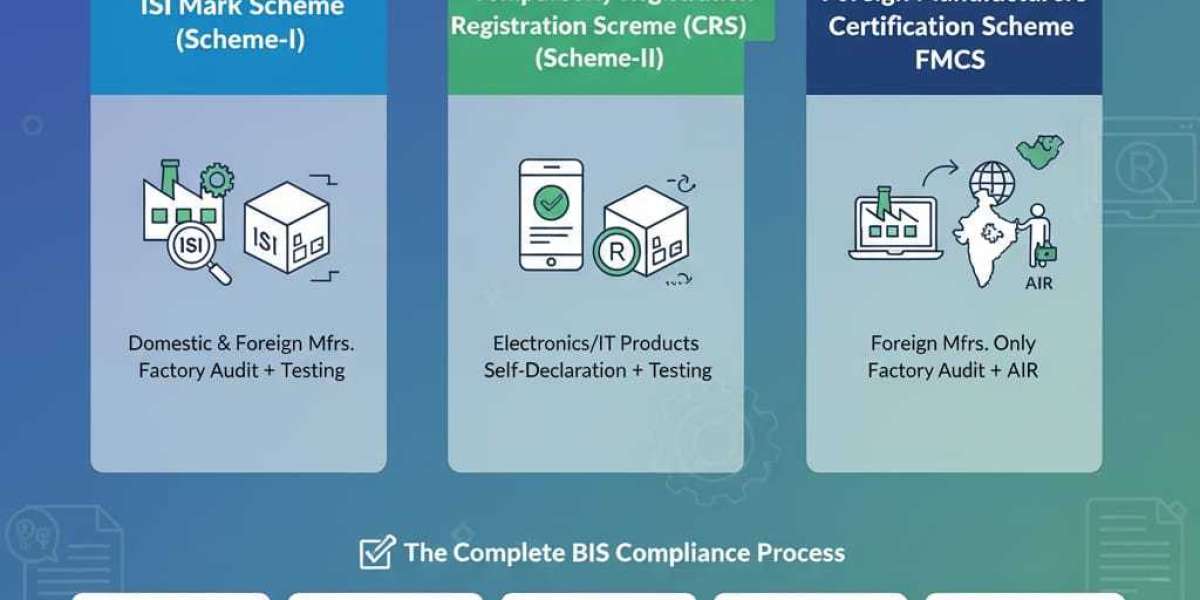
Types of BIS Certification
There are different types of BIS Certification depending on the product category:
1. ISI Mark Certification
Used for domestic manufacturers. Products like cement, steel, and electrical appliances require this certification.
2. CRS (Compulsory Registration Scheme)
Mandatory for electronics and IT products such as:
- Mobile phones
- LED lights
- Laptops
3. FMCS (Foreign Manufacturers Certification Scheme)
Required for foreign manufacturers exporting products to India.
What is BIS License / BIS Licence?
A BIS License (also written as BIS Licence) is an official permit granted by BIS that allows manufacturers to use the BIS standard mark on their products. Without a valid BIS License, businesses cannot legally sell certain regulated products in India.
What is BIS Registration?
BIS Registration is mainly used for electronic and IT products under the CRS scheme. It involves registering products with BIS after testing them in recognized laboratories.
Key points:
- Mandatory for many electronic products
- No factory inspection required (in most cases)
- Faster compared to other certification schemes
Benefits of BIS Certification
Obtaining a BIS Certificate provides multiple advantages:
1. Legal Compliance
Ensures your product meets Indian government regulations.
2. Consumer Trust
Products with BIS mark are trusted for quality and safety.
3. Market Access
Allows you to sell products across India without restrictions.
4. Brand Reputation
Enhances credibility and strengthens your brand image.
5. Competitive Advantage
Certified products stand out in the market.
Step-by-Step Process for BIS Certification
The process of obtaining a BIS Certification involves several steps:
Step 1: Identify Applicable Standard
Determine the relevant Indian Standard (IS) for your product.
Step 2: Product Testing
Get your product tested in a BIS-approved laboratory.
Step 3: Application Submission
Submit the application for BIS Registration or BIS License along with required documents.
Step 4: Factory Inspection
For certain schemes, BIS officials inspect the manufacturing unit.
Step 5: Grant of Certificate
After successful verification, the BIS Certificate is issued.
Documents Required for BIS Certification
To apply for a BIS License or BIS Registration, you need:
- Business registration proof
- Manufacturing unit details
- Product test reports
- Identity proof of applicant
- Authorization letter (if applicable)
Products Covered Under BIS Certification
Many products require mandatory BIS Certification, including:
- Electrical appliances
- Electronics and IT goods
- Construction materials
- Household products
- Automotive components
Selling these products without a BIS Certificate can lead to penalties and legal action.
Difference Between BIS License and BIS Registration
Feature | BIS License | BIS Registration |
Applicable for | Domestic foreign manufacturers | Electronics IT products |
Inspection | Required | Usually not required |
Mark Used | ISI Mark | CRS Mark |
Process Time | Longer | Faster |
Common Challenges in BIS Certification
Businesses often face issues such as:
- Complex documentation
- Delays in product testing
- Lack of clarity in standards
- Compliance errors
Proper guidance can simplify the BIS Certification process and save time.
Conclusion
Getting a sunconsultants.co.in. is essential for businesses that want to sell regulated products in India. Whether you need a BIS License, BIS Licence, or BIS Registration, understanding the process helps you avoid delays and legal issues. From ensuring product safety to building customer trust, BIS Certification plays a crucial role in business growth. By following the correct steps and maintaining compliance, you can easily obtain certification and expand your market reach.