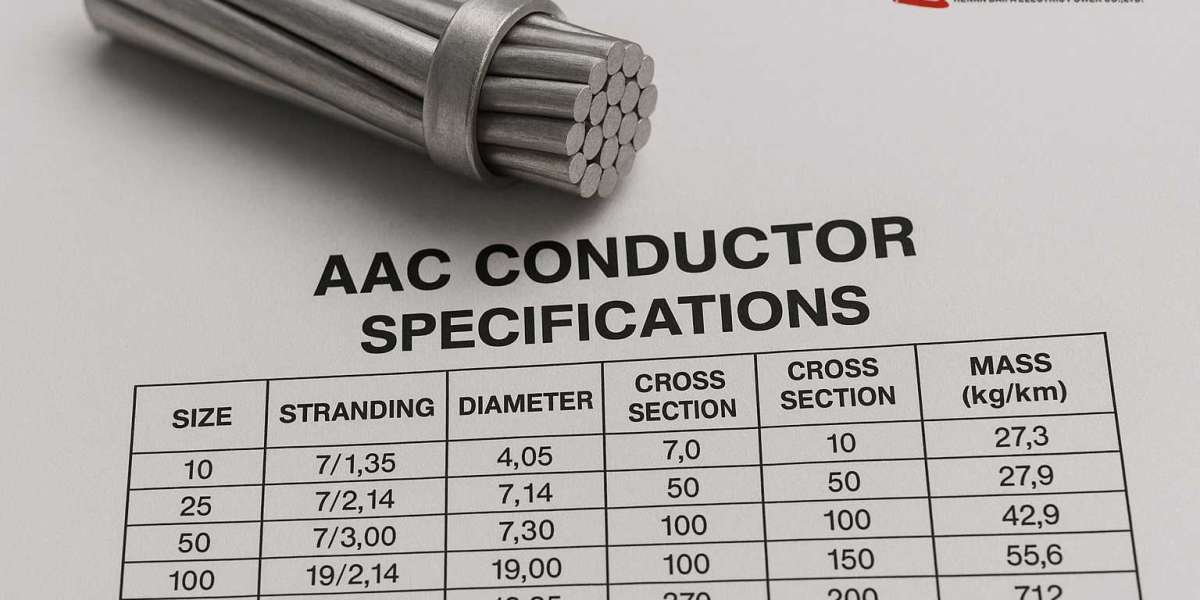

In today’s fast-growing power transmission and distribution networks, utilities and EPC contractors must balance reliability, cost efficiency, and fast deployment. Among the most widely specified overhead line products, the AAC conductor continues to play an important role in urban and coastal power projects where corrosion resistance and lightweight construction are essential.
An AAC conductor (All Aluminium Conductor) is manufactured using high-purity aluminium strands and is designed primarily for short-to-medium span overhead distribution and transmission lines. Compared with steel-reinforced alternatives, AAC offers excellent electrical performance, low weight, and simplified installation.
As a global manufacturer of overhead conductors and power cables, HNBF Power supplies a full range of AAC, AAAC, ACSR and ABC solutions for utility grids, substations, and infrastructure projects worldwide. This guide explains how AAC conductors work, where they perform best, and how engineers and procurement teams can select the right specification with confidence.
What Is an AAC Conductor?
An AAC conductor is a stranded conductor made entirely from aluminium wires, typically produced from EC-grade aluminium with very high electrical conductivity.
Unlike ACSR or AAAC, AAC does not contain any steel or alloy core. The entire conductor is composed of concentric layers of aluminium strands.
Key Construction Features
100% aluminium stranded conductor
Lightweight structure with uniform flexibility
High surface area for improved heat dissipation
Non-magnetic and non-corrosive construction
This simple design allows AAC to deliver strong electrical performance while remaining easy to handle during installation.
Why Utilities Choose AAC Conductor for Distribution Networks
The primary advantage of an AAC conductor lies in its excellent conductivity-to-weight ratio. For many low and medium voltage overhead distribution systems, this translates directly into reduced losses and lower installation cost.
Main Technical Advantages
High Electrical Conductivity
AAC conductors offer higher conductivity than many alloy-based conductors. This helps utilities reduce line losses and improve overall network efficiency.
Superior Corrosion Resistance
Because AAC contains no steel, it performs exceptionally well in coastal, industrial, and polluted environments where corrosion risk is high.
Lightweight and Easy Installation
Lower mass per kilometer reduces tower and pole loading, simplifies stringing operations, and lowers transportation costs for large projects.
Lower Material Cost
For short-span and urban distribution networks, AAC often delivers a more economical solution than reinforced conductors.
Typical Applications of AAC Conductor
The AAC conductor is widely used in:
Urban and suburban overhead distribution lines
Coastal transmission corridors
Industrial plant power networks
Utility service lines and feeders
Substation interconnections with short spans
For projects with limited span lengths and moderate mechanical loading, AAC provides a highly practical solution.
AAC Conductor vs AAAC and ACSR – How Should Engineers Decide?
Selecting the correct overhead conductor depends on both electrical and mechanical requirements.
AAC vs AAAC
AAAC conductors use aluminium alloys to increase tensile strength. While this improves mechanical performance, it slightly reduces conductivity.
AAC → better conductivity, lower strength
AAAC → higher strength, slightly lower conductivity
AAC is generally preferred for urban and coastal environments where long spans are not required.
AAC vs ACSR
ACSR conductors incorporate a steel core to significantly increase tensile strength. However, this introduces corrosion risk and additional weight.
AAC → lightweight, corrosion resistant
ACSR → strong, suitable for long spans and heavy loading
For short spans and distribution networks, the AAC conductor often provides a more balanced and cost-effective option.
Key Technical Parameters to Specify for AAC Conductor
When preparing technical specifications or procurement documents, engineers should focus on the following parameters:
1. Conductor Size and Stranding
Number of strands and individual wire diameter directly affect current capacity, flexibility, and installation behavior.
2. Electrical Performance
Rated DC resistance, current-carrying capacity, and temperature rating must align with network load requirements.
3. Mechanical Properties
Although AAC is not designed for long-span transmission, minimum breaking load and sag characteristics remain critical for safe installation.
4. Applicable Standards
AAC conductors are typically manufactured in accordance with internationally recognized standards to ensure consistent performance and quality.
At HNBF Power, AAC conductors are produced under strict quality control systems and supplied with full test reports, dimensional verification, and electrical performance certification for utility and EPC customers.
Manufacturing Quality Matters for AAC Conductor
The performance of an AAC conductor depends heavily on aluminium purity, stranding precision, and surface finish. Poor stranding accuracy can lead to uneven tension, installation difficulties, and premature service issues.
HNBF Power operates modern stranding and testing lines for overhead conductors, supplying:
AAC conductors for distribution and transmission projects
AAAC and ACSR conductors for higher mechanical demands
ABC and low voltage power cables for integrated grid solutions
By offering a complete overhead and power cable portfolio, HNBF Power supports utilities seeking consistent supply, stable lead times, and unified technical documentation across multiple product categories.
FAQs About AAC Conductor
1. Is AAC conductor suitable for long-span transmission lines?
AAC conductor is mainly designed for short-to-medium spans. For long spans and high mechanical loading, AAAC or ACSR conductors are usually more appropriate.
2. Can AAC conductor be used in coastal environments?
Yes. One of the main advantages of AAC conductor is its excellent resistance to corrosion, making it well suited for coastal and high-humidity areas.
3. Does AAC conductor carry more current than AAAC?
In most cases, AAC offers slightly higher conductivity than AAAC due to its pure aluminium construction, which can result in marginally better current-carrying capability.
4. How does AAC compare in lifecycle cost?
For urban distribution networks with short spans, AAC conductor often delivers a lower total lifecycle cost because of reduced corrosion risk and easier installation.
Partner with HNBF Power for Reliable AAC Conductor Supply
Choosing the right AAC conductor is not only about material selection—it is about securing consistent manufacturing quality, reliable logistics, and professional technical support throughout the project lifecycle.
As a global manufacturer of overhead conductors and power cables, HNBF Power supports utilities, EPC contractors, and grid infrastructure developers with customized AAC conductor designs, project-specific documentation, and stable long-term supply programs.
Contact HNBF Power today to discuss your AAC conductor requirements and receive customized solutions for your next overhead distribution or transmission project.